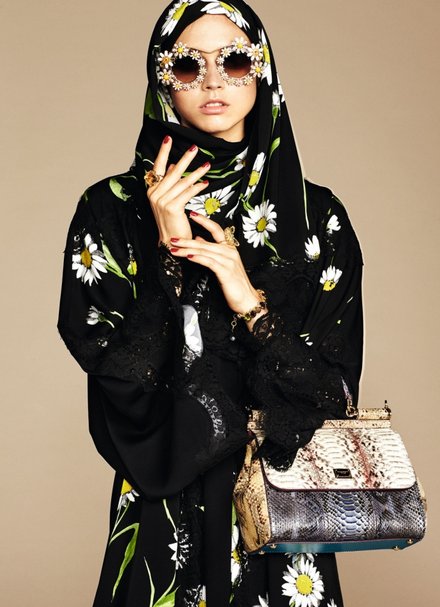
Following on the heels of an H&M ad campaign that featured a model clad in a hijab, today Dolce & Gabbana announced a collection of hijabs and abayas aimed at fashion-conscious Muslim customers.
This is absolutely brilliant business strategy every way you slice it.
While other designers like Donna Karan have done capsule collections aimed at Muslim women during Ramadan, Dolce & Gabbana’s line looks to be a permanent addition to their label, making them the first luxury line to cater to this large demographic — a Reuters report claims that Muslim shoppers spent $266 billion on apparel and footwear in 2013, a figure that is projected to nearly double by 2019. This line will be a smash hit, especially among the ultra-rich, because it is true to D&G aesthetics — dramatic Sicilian lace, quirky patterns, and baroque accessories — and I predict other designer labels will be following suit shortly.
This is also a great step towards inclusiveness in the fashion industry, which often seems like it’s built upon exclusivity. Additionally, it’s in line with D&G’s recent brand messaging, which suggests that the brand is for people of all ages, genders, and races, by including nonnas in ad campaigns and bambinos on the runway. This message is reiterated by the types of images Stefano Gabbana posts to Instagram with the hashtag #dgfamily and #dgwomenlovemakeup — images uploaded of real women with their makeup products and real families from all over the world with the Dolce & Gabbana branding added to the photos to look like a campaign. Some are glamorous, but many are not, and the result is refreshing, and not at all cloying. Still, it’s fair to note that all of the families that I saw in the gallery are heteronormative, and the D&G “women” only loving makeup is somewhat troubling. D&G has made a great stride forward with their hijab and abaya designs, but still has a way to go.
I’m looking forward to industry responses to this new line. Burberry might like to incorporate similar pieces to reinforce their inclusive messaging and because of how Muslim culture has become a part of Britishness today. I’d love to see Karl put his take on something like this, and it would be a logical step for Hermés, considering their signature accessory. Stay tuned, too for echoes of this on the runways next month — I have a feeling Celine-y modesty might be very in come February.
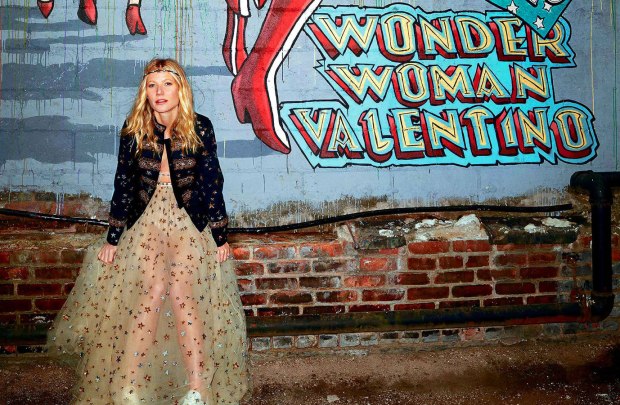
This week, Goop announced a collaboration with Valentino on a Wonder Woman-themed capsule collection. Comprised of 25 pieces ranging from sneakers to gowns, this collaboration is a great coup for Goop – Valentino is by far the highest-profile label Goop has ever partnered with, and Goop can also boast the distinction of being Valentino’s first-ever partnership with an outside label.
The brand pairing is excellent – the major fashion house will boost the much-derided Goop’s credibility, while working with Goop will reinforce the Chiuri and Piccioli-helmed Valentino as being youthful and not without a sense of humor. The Wonder Woman theme is incredibly random, but cute and apropos of the current feminist conversation, as well as an in-on-the-joke move aimed at Paltrow’s critics.
It seems like the perfect partnership – the resulting product, however, is mixed.
The pieces are genuinely stunning in person (I had the pleasure of visiting the Goop Pop-up store in New York yesterday) and beautifully constructed. But the price points are too high even for Goop’s altitudinous norm, with t-shirts and sneakers coming in at about $1,000 apiece, and a leather jacket for $10,000. The gowns, though, are truly special and worth the 5-digit price tags. Many of the pieces are also hard to wear or too novelty for everyday use, like the star-spangled denim hotpants, the similarly-decorated denim jumpsuit, and the completely sheer t-shirt. If Goop and Valentino were going to pursue these price points, they ought to have incorporated at least a few simpler pieces that would be worth the investment But then again, Valentino isn’t exactly known for its practicality – every piece is something special.
The collection seems to be doing well, with several pieces having already sold out just two days after the line’s debut. Apparently the price points haven’t been too much of a deterrent for online buyers, though most of the women in the pop-up store cast one frightened look at the Valentino rack and hightailed it to the more budget-friendly cosmetics section. Price points more akin to Valentino’s Red collection would have been much more accessible – and would have sold out immediately. Or at least caused a reaction more similar to the opening for Balmain x H&M, and less like white ladies nervously eyeing a $1,000 crown.
I certainly hope to see more high-profile collaborations with Goop and even a brick-and-mortar store in the future. Gwyneth should leverage her celebrity friendships to this end. Could Tom Ford x Goop be next? The world might explode – or at least mine certainly would.
Last week, Burberry announced their decision to roll up all of their lines – Brit, London, and Prorsum – into one label. Henceforth, everything will be known as simply “Burberry.”
This decision follows similar moves other luxury labels have recently made to get rid of their “junior” lines: D&G and Marc by Marc Jacobs have both became defunct in the last year. Burberry’s consolidation is much more akin to Victoria Beckham’s swallowing up the lower-priced Victoria, Victoria Beckham (although London couldn’t exactly be seen as a junior line, pricewise).
Does this make sense from a business perspective? I suppose. To the untrained shopper, the different labels might be confusing. But I think Christopher Bailey ought to have cut out London, and kept Brit and Prorsum as bookending collections – but perhaps this is my own sentimentality talking.
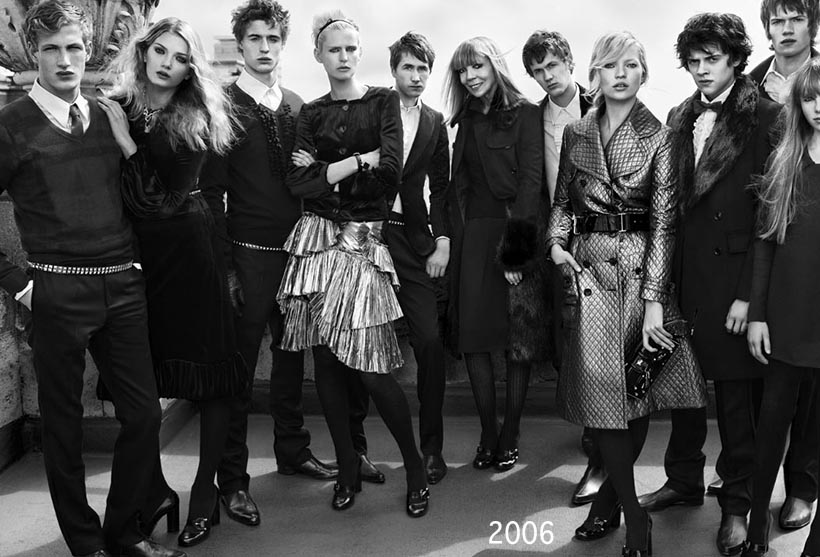
When I was first discovering fashion, Burberry was the brand I deeply identified with, soul-loved. I obsessed over it; the black and white ads covered my walls (and still do in my childhood bedroom); I finally felt like a world understood me and my interests and tastes and aesthetics. I would look at the Brit line on Nordstrom.com and think that one day I might be able to afford a piece. I contented myself with the fragrances (this was a pre-Burberry Cosmetics era – imagine!) and then one day, at sixteen, I garnered the nerve to go into a Burberry store with my mother. There was a black eyelet cotton Brit dress on sale. We bought it. It was an important psychological shift for me – I finally owned a piece of the world I wanted to live in. I was me. And I would go on to make wonderful memories whist wearing that dress, and it’s something I will keep forever. Brit’s differentiation from the other Burberry price points made that possible.
Besides my maudlin affection for the Brit line, Bailey should keep it because it’s so distinctive from the runway collections. Brit is made up of classic pieces, like sweaters and polos, starting at about $300, and usually incorporate the house’s logoistic check pattern. It’s a starter line that’s clearly identifiable as Burberry for those who don’t have the budget to afford the higher-priced London line, or a penchant for a pastel trench coat from the Prorsum collection. Without the identifying nomenclature, I feel like Burberry’s enormous inventory will be difficult to navigate, and perhaps turn away new-to-fashion buyers, who only see thousand-pound dresses and leave, unaware that they can afford something less pricey.
And as for Prorsum – Latin for ‘forward’ – that designated the high-fashion runway collections, well that’s a shame to lose. It’s a word that evokes the Burberry knight, and Burberry’s unique ability to move forward stylistically while still remaining a heritage brand. Not to mention its erudition factor – it also brings to mind a romantic vision of Oxford and Cambridge. Something like this, which, coincidentally, is the aforementioned wall décor:
I’m sure Bailey has good reason for the roll up – I trust him and his vision for the brand, even though I wish he wouldn’t make this particular move. So who’s next to streamline their label? Kors won’t – yet. There’s too much of a price gap between Michael, Michael Kors and the Michael Kors Collection, and besides, he should want to keep the two separate to placate both the label-toting suburbanites loonies with brand ownership, and the starlets he dresses on the red carpet with a non-embarrassing connotation. Armani won’t yet either. There will always be a Eurotrash market for Armani Exchange on one hand, and a market for sophisticated actors to wear his suits on the red carpet on the other. How are these label stratifications even part of the same brand? They are so antithetical – not at all like Burberry’s or even Marc Jacobs’ lower-priced lines, which simply reflect(ed) the larger brand at a lower price point. I suppose a powerful name can code for a lot of different things to different audiences – but I’m not sure that’s a compliment to Mr. Kors or Mr. Armani.
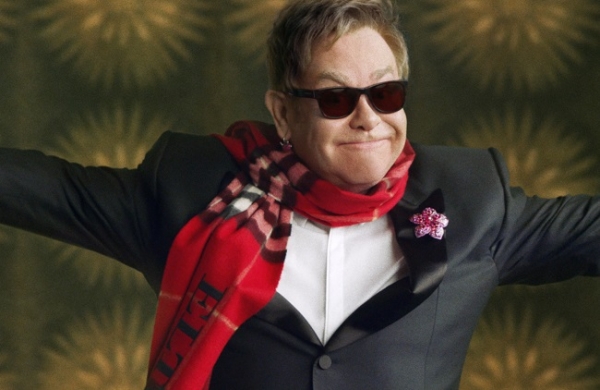
Burberry also debuted its holiday video advert last week. No luxury label does holiday marketing quite like Burberry, and the label delivered once again, with a star-studded tribute to Billy Elliot, with appearances by Romeo Beckham, Elton John, Julie Walters, Rosie Huntington-Whitely, George Ezra, Naomi Campbell, Michelle Dockery, and James Cordon, just to name a few. That’s what’s so special about Burberry – all of these faces perfectly fit the label. It doesn’t matter if you’re male or female, black or white, 13 (Beckham) or 68 (Sir Elton), Burberry is for everyone. They consistently strike a unique pitch of inclusiveness, while still maintaining luxury, aspirational status. Perhaps that’s the heritage factor, but I’d chalk it up to a special British alchemy.
Allow me to begin by by saying just how deeply I love Tom Ford. I often dream about him. I would take a bullet for him. I am frequently washed over with a nausea-like feeling of deep jealousy of Richard Buckley.
Which is why gives me great displeasure to say that I did not remotely like or understand why Mr. Ford decided to show his Spring/Summer 2016 Womenswear collection in a three-minute video format.
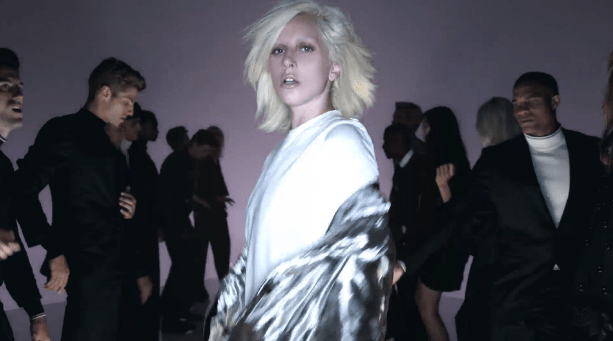
In the Nick Knight-directed video, models disco down a runway and are cheered on by other dancing models in the frow, as it were. Quick cuts and high-energy movement give it a music video feel. Lady Gaga shows up and the dancing continues. I walked away feeling dizzy, wondering what exactly I had just watched – it certainly did not have the usual sexy, mysterious, over-the-top Tom Ford Feel.
Videos are nothing new for fashion shows. Most designers livestream their runway shows, allowing people around the world to watch in real time. This is a fantastic and democratizing tool for fans, bloggers, and buyers, who can experience the show firsthand, and not rely solely on still photos or critics’ commentary. However, the short video format Mr. Ford implemented for S/S ’16 simply is not an effective media for viewing a fashion show. The focus is entirely on mood which, granted, is important, but the viewer walks away with no recollection of what the clothes looked like – a factor that will certainly prove problematic when it comes down to pre-ordering and retail. And then, there’s the missed opportunity. Mr. Ford is one of the great showmen of our time. He is the king of spectacle, masterful at setting a scene and manipulating an audience (see: deep carpet of rose petals falling from the ceiling at F/W 2015), and deeply obsessive about his work. Why would he pass up this opportunity to display his showmanship, and instead send out something that felt last-minute?
The choice to make a video likely mirrors where Mr. Ford is creatively. He is about to start filming his second film, Nocturnal Animals, and is likely deeply ensconced in the medium of film. The video is more likely in reaction to the film project—perhaps he simply didn’t have the time to produce a sumptuous live show because of his other creative endeavors.
Then there is the alarming issue of Lady Gaga’s presence. Why she was cast as the face of this video initially seems unfathomable, as she has been musically and culturally irrelevant for some time now, and doesn’t espouse the Fordian ideals in the way that, say, Carine Roitfeld and Rihanna do. If Mr. Ford was looking for a new face for the S/S Campaign, he should have gone with Lucky Blue Smith, who also makes a cameo in the film. Having a male model front the womenswear campaign would have been edgy and in line with the current androgynous movement, and Lucky Blue has that special charismatic Ford Factor that Gaga lacks. However, as Lucky Blue is relatively unknown outside the fashion world, and the collection is already forgettable because of its format, it makes sense that the label would go with a universally known celebrity to front the campaign. Choosing Gaga was more of a necessary strategic, and not an artistic, decision due to the video format.
Although Ford’s video format was well received by the media, it is doubtful that it will become a trend in fashion shows. The short film makes the pieces forgettable, lacks a sense of drama and narrative, and distorts brand identity. The best place for videos in fashion are for marketing purposes—setting a scene, depicting a short narrative, and ultimately reinforcing the brand’s meaning. Prada does an especially good job with this, and Dior is beginning to break into the medium as well (Miss Dior and Dior Addict fragrances have been making fantastic videos for the last five years or so). Burberry smartly has an “Acoustic” music video channel, featuring independent British acts performing exclusive sets for the brand, which reinforces the cool, youthful, Britishness that Burberry promotes. Even Ford has used this format to promote his cosmetics, both for the Lips & Boys collection and the men’s skincare line, to great effect — which is why his fashion show video was such a disappointment.
What Ford’s video really makes me wonder is if he’s getting ready to leave fashion again. I’m still suffering from abandonment issues from when he took a break to make A Single Man in the late aughts. I’m afraid he’s going to go out one Sunday morning to buy a wide-lapel jacket and never come back. Ford’s true skills lie in creating a world, a brand, and his obsessive attention to detail and instincts in setting a mood serve him well here whether he is making a collection or a film. I think it’s fantastic that he’s pushing himself creatively to explore new media and put his extraordinary eye to good use, but I’m not ready to see him go from the fashion world. I’m afraid this S/S ’16 womenswear video is indicative of Ford hedging his bets, deciding between continuing as a designer, or pursuing filmmaking or other artistic endeavors, perhaps even full-time.
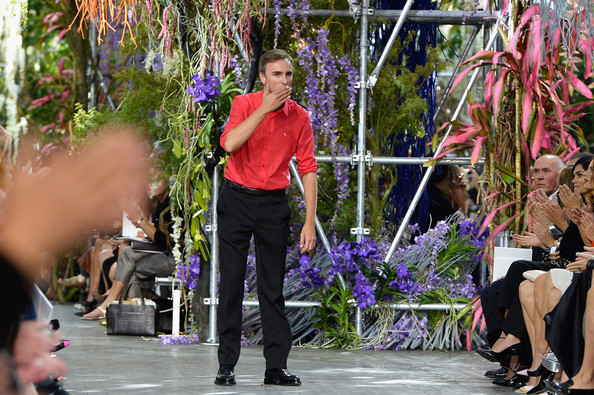
Another designer leaves a major fashion house after only a short tenure. Raf Simons is unexpectedly out at Dior. I was initially astounded to hear this news, but the more I thought about it, it the more it made sense to me. He did beautiful things at Dior, but it never truly felt like he was comfortable there. You can see it in some the clothes, especially later on in his tenure – they’re ladylike, but feel cold and vaguely discomforted. Still, I’m surprised to see him leave so soon, especially after the publicity boost due to the recent release of Dior and I, the documentary charting the making of his first collection at the company.
Hopefully, this also means the end of Jennifer Lawrence as the face of the brand; a completely baffling pairing that benefits Lawrence’s personal brand, but hurts Dior’s. The house desperately needs to re-focus its brand identity, because as it is, they’re gunning to look like Giannini’s Gucci. Under Raf, Dior didn’t stand for anything – I don’t know who the customer is, or what kind of world she inhabits, because all of the advertising was restrained, empty, and faced by a bland big-time movie star — I had to get all of my information about the brand from the runway shows, which, admittedly, were stunning. The ads need to be a more sophisticated (but not boring) version of the vision so perfectly executed by their fragrance campaigns, especially Miss Dior and Dior Addict – French, ladylike, and daring.
What’s next for Raf? I wish he would go back to Jil Sander, an all-time favorite of mine that has crumbled since he left in 2012, but he won’t loop back around to the same company. He will focus on his own label, and perhaps another smaller line. I don’t ever see him returning to one of these mega-houses, even if the fashion cycle slows down to fewer collections per year.
But the even bigger question is who will replace Raf. Will Dior follow the current trend among big houses and pick an unknown? Perhaps, but that move would look trite after the recent Balenciaga appointment. I personally would love to see a woman at Dior. Cathy Horyn teased the possibility of Phoebe Philo on The Cut, which would be sublime; however I don’t think Philo would be willing to split her time between Céline and Dior, especially, as Horyn noted, because she has so much creative control over every aspect of Céline. Nadège Vanhee-Cybulski at Hermès might be a good choice, as would Stella McCartney, although I think, like Philo, McCartney is more invested in her own label at the moment. Kate and Laura Mulleavy would be a unexpected choice, but I think the sisters behind Rodarte are too media-shy to want to helm a major house like Dior. If I were Mr. Arnault, however, I would be pursuing Jonathan Anderson. He’s ultra-talented, young, a media darling, and not afraid of helming a big fashion house. It may be strategically savvy for Anderson to stay at Lowe, though, and build a mega name for himself, much like Philo did at Céline.
I’m sad to see Raf go — I was looking forward to see how he evolved as a designer at Dior. But in any case, I’ll be extremely interested to see who gets the appointment, and what they do with the brand. Stay tuned.


 Veni Vidi Vesti